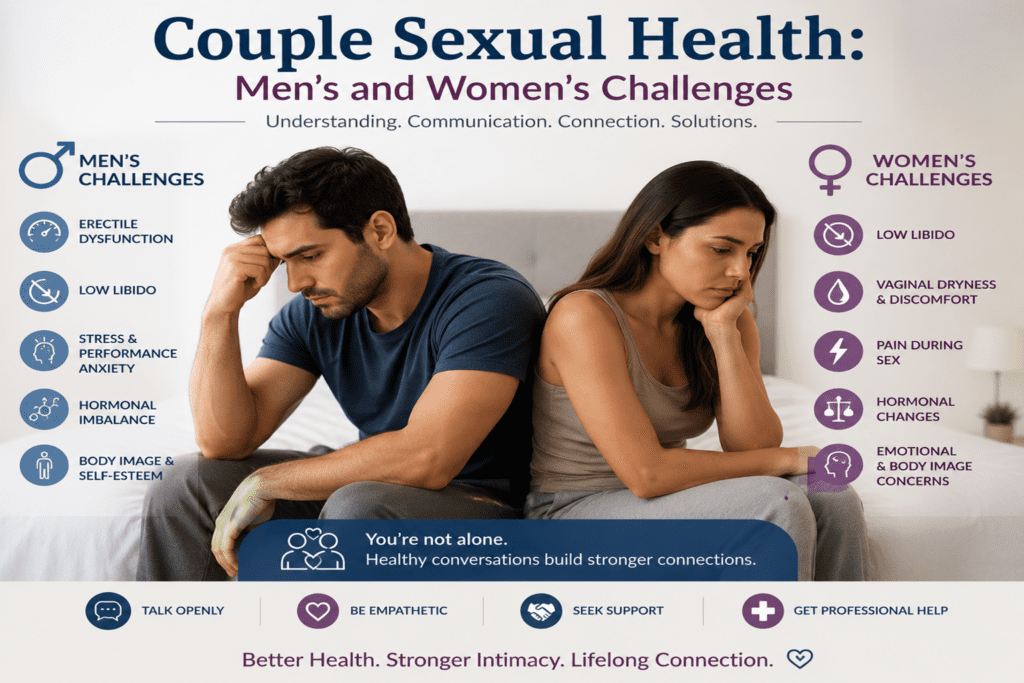
We don’t talk about it enough, do we? When a relationship is firing on all cylinders, intimacy feels easy. It flows naturally. But when something goes wrong in the bedroom, it casts a massive, quiet shadow over everything else. Suddenly, a space that should be full of comfort and connection becomes a source of thick anxiety and heavy silence.
The biggest mistake most of us make is treating a sexual difficulty as an isolated, individual flaw. We think of it as “his problem” or “her problem.” But sex is a shared dance. If one partner is struggling, the rhythm breaks for both people. What starts as a physical hiccup for one person can quickly transform into a complex emotional knot for the couple.
Let’s pull back the curtain on what is actually happening. By breaking down the unique challenges men and women face, we can see how these issues feed into each other—and more importantly, how couples can team up to overcome them.
The Male Side of the Coin: Performance and Pressure
For men, sexual health and self-worth are deeply, almost stubbornly, intertwined. From a very young age, societal messaging tells men that their masculinity is directly tied to their performance, stamina, and ability to be ready at a moment’s notice. When the body doesn’t cooperate with that script, the psychological fallout can be intense.
1. Erectile Dysfunction (ED)
Erectile Dysfunction is incredibly common, yet it remains one of the most heavily guarded secrets in men’s lives. It is simply the inability to get or keep an erection firm enough for satisfying sex.
While ED can certainly be triggered by physical health factors—like poor blood circulation, high blood pressure, diabetes, or even drinking too much alcohol—the mind plays a massive role. The moment a man experiences ED just once, a ticking clock of anxiety starts in his head. The next time intimacy is on the table, he isn’t thinking about pleasure; he is worrying about whether his body will fail him again.
- The Partner’s Perspective: When a man pulls away or struggles with an erection, his partner rarely thinks, “Oh, this must be a blood flow issue or stress from work.” Instead, the partner’s mind immediately jumps to insecurity: “Is he not attracted to me anymore? Is he having an affair? Did I do something wrong?”
2. Premature Ejaculation (PE)
On the other end of the spectrum is Premature Ejaculation, where a man reaches climax much sooner than he or his partner wants—often within just a minute or two of penetration. This is particularly prevalent in younger men or during periods of immense life stress.
PE is deeply frustrating because it cuts the experience short, often leaving the partner sexually unfulfilled. The man is left sitting in a puddle of immense guilt and shame, feeling like he has let down the person he loves. Over time, he might start avoiding sex altogether just to escape that feeling of failure.
3. Low Testosterone and Dropping Desire
We often assume men are always in the mood, but that is a myth. Low testosterone (Low T) can hit men as they age, or even earlier due to poor sleep, intense stress, and health issues. It drains their energy, dampens their mood, and causes their libido to plummet. It is a quiet struggle because a man might want to want sex, but the biological engine just isn’t turning over.
The Female Side of the Coin: Complexity, Pain, and Connection
While male sexual challenges often center around physical mechanics, female sexual health is a beautifully intricate, highly sensitive matrix of hormones, physical sensations, and deep emotional safety. For many women, the brain is the ultimate sexual organ. If the brain is stressed, distracted, or feeling disconnected, the body will shut down the gates.
1. Low Sexual Desire (HSDD)
Hypoactive Sexual Desire Disorder is a persistent lack of interest in sex that causes personal or relational distress. It is vital to understand that women’s desire often works differently than men’s. Men frequently experience “spontaneous desire” (it just pops up out of nowhere). Women, however, more regularly experience “responsive desire.” This means they might feel completely neutral about sex initially, but as physical touch, warmth, and emotional connection begin, their desire wakes up.
When a woman has low desire, she isn’t acting out of malice or trying to punish her partner. She might simply be carrying an overwhelming mental load—managing a household, a career, kids, or family stress. When a mind is running a never-ending to-do list, turning on a sexual mindset feels nearly impossible.
2. Painful Intercourse (Dyspareunia and Vaginismus)
Sex should never hurt. Yet, thousands of women suffer through painful intimacy in silence.
- Dyspareunia is a broad term for recurrent pain during sex. It can happen due to a lack of natural lubrication, vaginal thinning during menopause, infections, or underlying conditions like endometriosis.
- Vaginismus is a deeply distressing condition where the muscles around the vagina involuntarily spasm and tightly close up whenever penetration is attempted. It is a protective reflex of the body, often triggered by a fear of pain or past trauma.
When sex hurts, the body learns to associate intimacy with danger. Naturally, a woman will start avoiding even simple affection like kissing or cuddling, because she worries it will lead to an expectation of painful sex.
3. Difficulty Achieving Orgasm (Anorgasmia)
Many women struggle to reach orgasm, either taking a very long time or finding it impossible during intercourse alone. Because popular media falsely portrays women climaxing effortlessly from penetration alone, both women and their partners end up feeling like something is broken. In reality, most women require direct clitoral stimulation to peak, and a lack of open communication about this fact leaves many encounters feeling incomplete.
How Individual Struggles Turn into a “Couple’s Problem”
When these individual challenges go unaddressed, they slowly twist into a shared relational knot. It usually follows a predictable, painful cycle.
Let’s look at a common scenario: A man experiences an episode of ED. He feels ashamed, so the next night, he avoids sitting close to his wife on the couch because he doesn’t want to spark something he can’t finish. His wife notices him pulling away and assumes he is losing interest in her. She feels rejected, so she grows cold and distant to protect her own feelings.
Now, both people are sleeping on the far edges of the mattress, separated by a wall of unspoken resentment. The original physical problem has morphed into an emotional chasm.
This is where the paradigm shift has to happen. You have to stop looking across the room at your partner as the problem. The problem is the barrier between you, and you have to team up against it.
Practical Steps to Reclaim Your Intimacy
If you find your relationship caught in this loop, take a deep breath. It is incredibly common, and it is entirely salvageable. Here is how you can start breaking down the walls.
1. Shift Your Communication to a Neutral Zone
Never try to sort out your sexual frustrations while you are naked, in the bedroom, or right after a disappointing encounter. The vulnerability is far too high, and defenses will jump up immediately.
Instead, talk about it in a neutral, low-stakes environment. Bring it up while you are driving in the car, washing the dishes together, or out for a walk. Use “I” statements rather than “You” statements. Instead of saying, “You never want to have sex anymore,” try saying, “I really miss feeling close to you physically, and I want us to figure out how to get back there.”
2. Take Intercourse Completely Off the Table
It sounds counterintuitive, but one of the best ways to fix a broken sex life is to ban penetration for a couple of weeks. When you remove the expectation of “the grand finale,” you instantly vaporize performance anxiety.
Try using a famous sex therapy technique called Sensate Focus. Take turns touching each other’s bodies—massaging hands, rubbing shoulders, stroking hair—while completely avoiding the genitals. It forces both of you to slow down, drop your anxieties, and relearn how to enjoy the simple, soothing sensation of your partner’s skin without fearing failure.
3. Redefine What “Sex” Means
Who decided that intimacy only counts if it involves a specific sequence of actions? If physical pain, illness, or erectile difficulties are making traditional intercourse tough right now, expand your toolkit. Kissing, mutual masturbation, using toys, or simply holding each other tightly while naked are all deeply valid, highly intimate ways to preserve your bond while your bodies heal.
4. Bring in an Expert
You wouldn’t try to fix a complex car transmission problem by just staring at the engine and arguing about it; you’d take it to a mechanic. Your sexual health deserves the same respect.
Seeking help from a seasoned expert can cut through months of confusion. Consulting a specialized professional like Dr. Jolly Arora, who deeply understands both the physiological and psychological landscapes of sexual health, can provide an immense sense of relief. A specialist can help rule out underlying medical issues—like hormonal drops or circulatory concerns—while providing tailored counseling to heal the communication gaps between you and your partner. There is absolutely no shame in getting a roadmap from someone who studies the terrain for a living.
Conclusion: You are a Team
At the end of the day, a couple’s sexual health isn’t measured by how perfectly their bodies perform according to some idealized standard. It is measured by how safely they can navigate the natural bumps, changes, and health challenges that life throws their way.
Our bodies change as we age, stress levels wax and wane, and health crises happen. But if you can look at your partner through a lens of empathy rather than frustration, you turn a painful wedge into an opportunity to build a much deeper, more resilient kind of intimacy. Stop carrying the burden alone, drop the blame, and remember that you are on the same side.
Frequently Asked Questions (FAQs)
1. Is it normal for couples to go through long dry spells due to sexual health issues?
Yes, absolutely. It is incredibly common. Whether it’s due to the birth of a child, chronic stress, aging, or a medical issue like ED or pain, most long-term couples hit phases where their sexual connection slows down or stops. The key is ensuring that a physical dry spell doesn’t turn into an emotional one.
2. How can I talk to my male partner about his erectile issues without hurting his pride?
Approach the topic with immense reassurance and zero blame. Frame it around his overall well-being rather than just his performance in bed. You might say something like, “I’ve noticed you seem stressed and things have been a bit difficult for us lately. I love you and miss our closeness, but I want you to know there’s no pressure. Maybe we can look into it together to make sure you’re feeling okay health-wise.”
3. Why does my partner lose interest in sex when they are stressed, while I want it more?
People process stress differently. For some, stress floods the body with cortisol and adrenaline, triggering a “fight or flight” response that completely shuts down sexual desire (as the body prioritizes survival over reproduction). For others, sex is a comforting release, a way to escape stress and feel close. Understanding that your partner isn’t rejecting you, but is simply overwhelmed by life, can change how you respond to their distance.
4. Can lifestyle changes actually improve couple sexual health?
More than you might think. Simple adjustments like getting consistent sleep, reducing alcohol consumption, eating a heart-healthy diet to improve blood circulation, and engaging in regular exercise can significantly lift testosterone levels, combat erectile issues, reduce vaginal dryness, and boost overall energy and mood.
5. When should we stop trying to fix it ourselves and see a specialist?
If you have tried talking about it, but every conversation ends in an argument or deeper silence, it is time to seek help. Furthermore, if there is physical pain involved for the woman, or persistent erectile difficulties for the man, you should consult a professional right away to address the biological root causes before they create deep-seated psychological anxiety.